
Bag making is forming, not just cutting
Once laminated film enters a bag-making machine, it passes through unwinding, tension control, heat sealing, cooling and cutting before it becomes a pouch that can be filled. The same film can produce pouches with identical dimensions but very different seals when the machine condition and settings differ.
Unwinding and tension
The roll must unwind smoothly and the tension must stay consistent from start to finish. Too much tension stretches the film and shifts dimensions and print position; too little allows wrinkles, folded layers or weak seals. When line speed changes, the tension system has to keep up, or consistency drifts within the batch.
Sealing and cooling
Heat sealing combines temperature, pressure and dwell time to fuse two or more layers. Too little heat gives a seal that peels; too much can shrink, embrittle or distort the seal area. Uneven pressure leaves thin spots.
Cooling matters as much as heating. The seal needs time to set before it is loaded or cut. Many seal defects are not caused by one temperature setting alone, but by the interaction of heat, cooling and tension.
Cutting and in-line checks
Cutting sets pouch length, trim and shape. Blade condition, feed accuracy and web guiding affect whether the cut is clean and the print stays centred. Production checks normally cover pouch length, seal width, appearance and print registration, with retained samples for the batch.
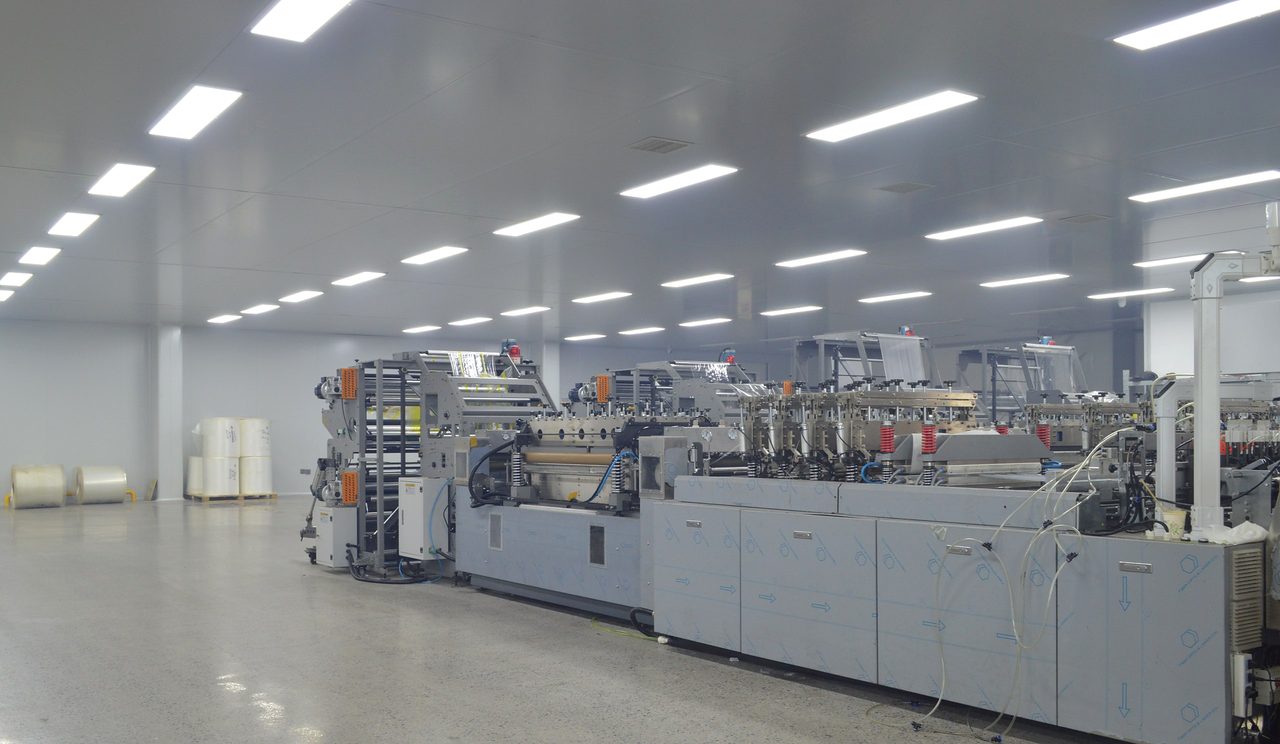
The photograph shows the general condition of the bag-making hall. It is not evidence of a particular pouch format, machine model or capacity. Settings are confirmed for each material structure, format and machine.
Working on a new pack?
Send us the product and target shelf life. We will help with the structure.